

What Is a "Momfluencer" (and Why the Definition Matters)
A “momfluencer” is a content creator whose identity, audience, and content are shaped, at least in part, by parenthood. But this definition undersells the category.
Mommy influencers span:
- Lifestyle moms (home, family, travel, and everyday routines)
- Niche moms (single moms, boy moms, special needs parenting)
- Expert moms (registered dietitians, pediatric nurses, teachers, therapists who are also parents)
- Working moms (career and parenting juggled openly and honestly)
- Millennial and Gen Z moms (digital natives raising the next generation of consumers)
What unites them? They hold enormous influence over household spending…and their audiences trust them deeply.
The Data Brands Can't Ignore
Women control the household wallet.
Women make or influence 85% of all consumer purchasing decisions in the U.S. This isn't a niche stat. It covers everything from groceries and personal care to electronics, financial services, and travel.
Moms are the primary purchase decision-makers across nearly every major CPG, health, home, and kids' product category.
Millennial moms are hyper-connected
The average millennial mom maintains 3.4 active social media accounts. She's on Instagram, Facebook, Pinterest, and TikTok…often simultaneously, often daily.
She's not a passive scroller. She's researching products, sharing reviews, tagging brands, and actively shaping what her community buys.
Mom content drives outsized engagement
Mom influencer content consistently outperforms general lifestyle content in key metrics:
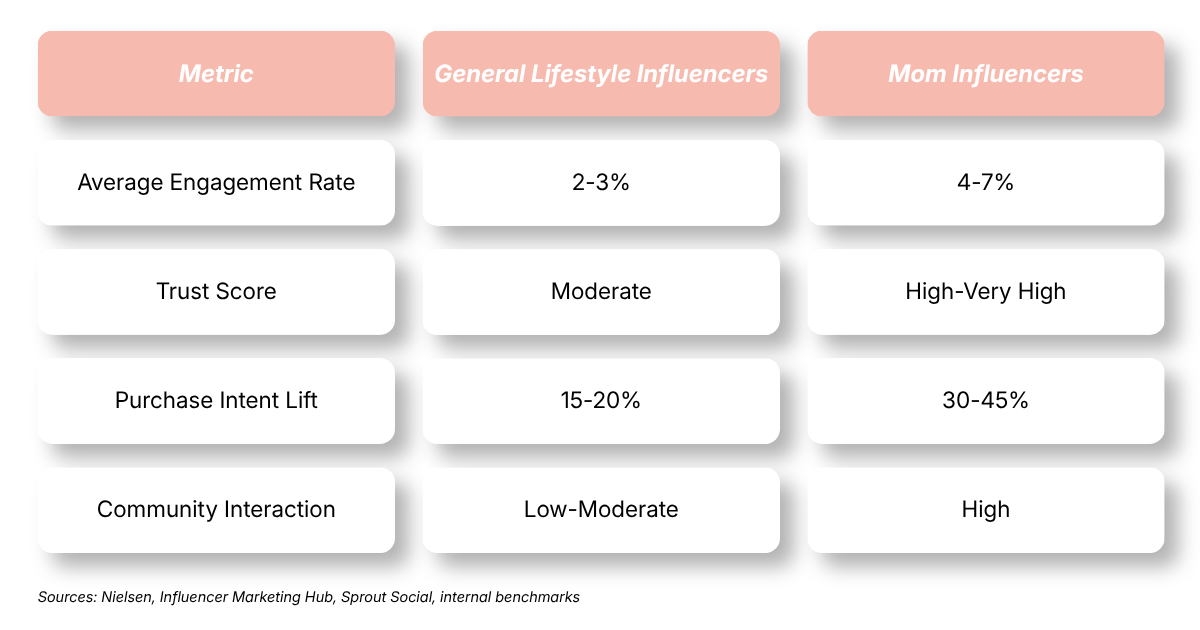
The reason? Moms build communities, not just audiences. Their followers ask questions, share experiences and buy based on recommendations.
Why Moms Are a Strategic Advantage, Not Just a Vertical
Most brands treat mom influencers as one niche among many. That's the wrong frame entirely.
Moms aren't a "nice-to-have" vertical. They are the primary decision-making demographic for the majority of consumer categories. Working with a skilled influencer marketing agency means recognizing this and building campaigns around it.
Here's what makes the mom creator category structurally different:
1. Multi-Category Purchase Authority
A single mom influences purchases across:
- Food and grocery
- Personal care and beauty
- Children's products (clothing, toys, education)
- Home and cleaning products
- Health, wellness, and supplements
- Pets
- Travel and experiences
- Financial products
Most influencer categories own one lane. Moms own the whole road.
2. Deep Audience Trust
Mom influencers build trust through vulnerability and consistency. They share the messy reality of parenting alongside product recommendations which makes those recommendations feel genuine, not transactional.
Research consistently shows that word-of-mouth from trusted peers drives more purchase decisions than traditional advertising. And for consumers, a mom influencer is a trusted peer.
3. Long Content Shelf Life
A mom influencer's audience often follows her through life stages: pregnancy, newborn phase, toddler years, school age, and beyond. A brand that builds a relationship with the right creator can maintain relevance across years of audience evolution.
This is rare in influencer marketing. Most niches have a shelf life. Motherhood doesn't.
4. Cross-Platform Dominance
Millennial and Gen Z moms are fluent across every major platform. For each platform you can expect a different format of content.
- Instagram (curated aesthetics, short form video, story content)
- TikTok (honest, raw, viral content)
- YouTube (long-form product reviews and tutorials)
- Pinterest (discovery and intent)
- Facebook Groups (community and conversations)
A brand partnership with one strong mom influencer can generate content across all five surfaces from a single campaign.

How Mom Influencer Marketing Works in Practice
Micro vs. Macro: Which Tier Wins?
The instinct is to chase big follower counts. The data says otherwise.
Micro mom influencers (10K–100K followers) typically outperform macro creators in:
- Engagement rate (5–9% vs. 1–3%)
- Audience trust
- Cost per acquisition
- Content authenticity
For most consumer brands, a portfolio of 10–20 micro mom influencers delivers better results than one celebrity partnership.
Macro mom influencers (500K+) are valuable for:
- Brand awareness and reach
- Launches that need scale
- Credibility signaling to retailers and press
We recommend using a tiered approach: anchor with 1-2 macro creators, amplify with 10–30 micro creators, and let organic community sharing do the rest.
What Good Mom Influencer Campaigns Look Like
Example 1: Baby Food Brand Launch
A baby food brand launching a new line partners with:
- 2 macro mom influencers (500K–1M followers) for launch week awareness
- 15 micro mom influencers (20K-80K followers) for authentic taste-test and feeding content
- A pediatric dietitian creator for credibility and expert positioning
Result: High-reach awareness + trust-building content + expert validation, all from the same campaign architecture.
Example 2: Cleaning Product Seasonal Campaign
A cleaning brand runs a "back to school reset" campaign with 20 home-focused mom influencers across TikTok and Instagram Reels. Content focuses on cleaning routines, organization tips, and honest product reviews.
Why it works: The content is genuinely useful. Mom audiences engage because it solves a real problem they're facing right now. The brand gets reach, content assets, and community-level word of mouth.
Example 3: CPG Brand Building Long-Term Equity
Rather than one-off campaigns, a CPG brand builds a Brand Mom Ambassador program: 8–12 mom creators under annual contracts who integrate the brand naturally into their lives. Content feels earned, not forced.
Over 12 months, this builds:
- Consistent brand presence in a trusted feed
- A content library of hundreds of authentic posts
- Community-level brand recognition with a high-purchase-intent audience
What to Look for in Mom Influencer Partnerships
Not all mom creators are equal. Here's what to evaluate before signing:
Audience Alignment
- Does her audience match your customer demographic?
- Where are her followers located (geo-targeting matters for retail brands)?
- What's the age split of her audience vs. her followers?
Engagement Quality
- Are comments genuine and conversational?
- Does she respond to her community?
- Are her followers asking for product recommendations?
Content Authenticity
- Does sponsored content feel native to her feed?
- Is there a consistent point of view and voice?
- Does she disclose partnerships clearly?
Platform Fit
- Is she strongest on the platform where your audience lives?
- Does she produce the content format your brand needs (Reels, Stories, long-form)?
A good influencer marketing agency will run this analysis at scale. We vet creators not just on reach, but on audience quality, brand safety, and content performance history.
The Business Case: ROI of Mom Influencer Marketing
The numbers make a clear argument.
Influencer marketing overall delivers an average ROI of $5.78 for every $1 spent. Mom influencer campaigns, when executed with the right creators and strategy, consistently outperform that benchmark.
Why? Because the audience is pre-qualified. Mom influencers speak to people who are actively buying for a household. They're not selling to passive audiences. They're selling to the person standing in the grocery aisle, the parent doing the school supply run, the household manager making the repeat purchase decision every single week.
The math for consumer brands is simple:
- Women drive 85% of consumer purchases
- Millennial moms average 3.4 active social accounts
- Mom influencer content drives 2–3x higher purchase intent than general lifestyle content
Brands that treat mom influencers as a strategic priority build durable consumer relationships in the most purchase-active demographic in the market.

How an Influencer Marketing Agency Maximizes Mom Creator Campaigns
Working with a specialized influencer marketing agency gives brands three structural advantages:
1. Creator Vetting at Scale - Agencies maintain relationships with thousands of vetted creators. They know which mom influencers have authentic engagement, which are rising, and which have the audience profile that matches your brand.
2. Campaign Architecture - The difference between a good influencer post and a great campaign is strategy. Agencies build campaigns with clear objectives, content briefs, timing, and measurement frameworks. We don’t just give you a list of creators.
3. Performance Measurement - Controversial opinion: reach and impressions are vanity metrics. Experienced agencies track what matters, which is earned media value, website traffic, conversion lift, and cost per acquisition. We give brands the data to make smarter budget decisions.
The Bottom Line
Mom influencers aren't a niche. They aren't a trend. They are the most strategically valuable creator category in consumer brand marketing.
They control household spending. They're trusted by their communities. They're active across every major social platform. And they drive purchase decisions in every category that consumer brands care about.
Working with the right influencer marketing agency to build a data-driven, creator-vetted, multi-platform mom influencer strategy is one of the highest-ROI decisions a consumer brand can make!
Looking to build a mom influencer strategy for your brand? The right influencer marketing agency will match you with vetted creators, build a campaign architecture that performs, and measure results that actually matter to your business.
Ready to launch a campaign? Book a call today with the experts at momfluence.co.